
The Significance of Community in Modern Planning Theory
David Chavis’ 1990 article, “Sense of Community in the Urban Environment: A Catalyst for Participation and Community Development," highlights the effects that perception of environment, social networks, and how residents’ sentiments about their communities can further influence the behaviors and perspectives of others. The article further emphasizes the importance of citizen participation in community organizing and explains why it has been regarded as key to improving the quality of the physical environment, enhancing services, preventing crime, and improving social conditions.

Reflections on: "Sense of Community in the Urban Environment: A Catalyst for Participation and Community Development," by David M. Chavis
David Chavis’ 1990 article, “Sense of Community in the Urban Environment: A Catalyst for Participation and Community Development," highlights the effects that perception of environment, social networks, and how residents’ sentiments about their communities can further influence the behaviors and perspectives of others. The article further emphasizes the importance of citizen participation in community organizing and explains why it has been regarded as key to improving the quality of the physical environment, enhancing services, preventing crime, and improving social conditions.
I view the institution of a locally-driven planning process as being essential to the establishment of a general sense of community. The maintenance and enlargement of self-sufficient, self-governing bodies (community organizations), further signify the additional role that empowerment has in local development. According to Chavis, a working definition of the term “sense of community”, suggests local processes of development that create opportunities for membership, influence, mutual needs to be met, and shared emotional ties and support. Essentially, a sense of community points to the strength and shared benefits of social capital. The more invested we are in community, the more power and ownership we feel we have in the communal environment. It is through this process that a sense of community contributes to individual thought for collective development.
I find it immensely intriguing, that when we compare communities that seem to be thriving, both socially and politically, to low-income communities, plagued with the accompanying concerns of crime, disinvestment and unemployment concentrated in a single area of poverty, one tends to wonder if there is a specific criterion of that qualifies it. Trends in both these specific communal types seem to possess a constant, regardless of country, city, location, ethnic makeup, etc. However one might evaluate the success of a community, the residents of perceivably well to do communities possess a notably stronger sense of community, than do residents of less socio-politically affluent communities. This sense of community therefore compels residents to develop and maintain social networks, in addition to in social capital. This investment in social capital is yet again, another product of that sense of community. A sense of community can have a great influence on one’s desire to control or contribute to the environment, often helping to address problematic concerns that may be regarded as problematic. For instance, I view the formulation of this ‘sense of community’ as being instrumental to the effectiveness of the Occupy Movement. A collective effort, with one voice, and a common goal. The control or occupying of space is but a means by which to establish an improvised locale for a “quartered” community. The resolve to maintain these claimed spaces was clear in the emergence of riotous protest as Occupiers clashed with law enforcement (in their attempts to divide the urban community, before conquering the social community). Another example of this can be seen in 1957’s, Little Rock’s Nine during the integration of Central High School. The local community viewed academic integration as problematic. When the National Guard intervened, (an additional group of “outsiders”) to enforce the law, the resistance became unpredictably explosive.
Although the concepts of Social Capital and Networks could quite easily take us into totally separate discussion altogether, in this context, I view social capital and social networks as being interdependent. Social capital deals with the product, the talent, skill or unique ability one contributes to the greater community with which he holds membership. Social networking speaks to the ways in which members of that community bargain to benefit one from another by the utilization of this collection of gifts and talents. All these are major players in the establishment and maintenance of a sense of community.
Apart from physical features, one of the key distinctions between these community types is the length to which residents will collectively go to protect “their” society. Examples of this are seen in high-price residential communities like Pleasanton, CA. for example. A highly expensive neighborhood where the rent you pay for a 2-3 bedroom condo, could match that of the cost of a home mortgage in parts of a city like Oakland. The economic support or disinvestment in local businesses is another way communities might protect their neighborhood. According to Chavis, perceived control relates to the beliefs an individual has about the relationship between actions (behavior) and outcomes.
The protection of a society further suggests that there are boundaries involved. These boundaries could be physical barriers such as gated communities, rivers, railroad tracks; or even socioeconomic barriers such as highly priced property, educational requirements, and other forms of exclusive criteria. These boundaries form due to society’s perception of “the other”. Therefore, in order to retain some sense of emotional security—to live without fears—communities tend to form boundaries in which to maintain, occupy, and repel others from entering.
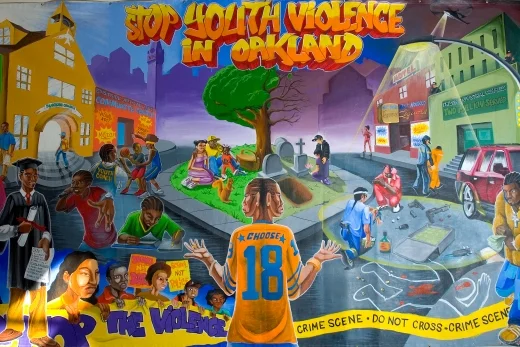
Working to help establish a sense of community in modern planning today should be held as a vitally important aspect of the planning process. The mural below depicts this perfectly. It was designed by a youth empowerment program in Oakland CA, Youth UpRising. The youth of Castlemont were included directly in the planning process. This mural is a reflection of what the young people view as the areas of concern in their community and what they actually want their community to evolve into. Considering the impact that community and developmental endeavors can have on the outcomes of specific regions, in order to further eliminate the formation and spreading of concentrated despair, community building must become a more integral part of the planning process.
Julian Collins is interested in topics of housing, community and economic development. He received his Bachelors from the University of Illinois, Chicago in Urban and Public Affairs and is now pursuing a Masters at the UC Berkeley in City and Regional Planning.
Who takes BART out to the Ball Game?
October 9, 2012

What BART riders pay for each trip is based on distance, and the fares are all calculated electronically, so the agency has a massive record of trip behavior by origin, destination, time and date. BART also notes happenings that affected ridership, such as major concerts, festivals, and sporting events. If you need to know the "bump" in ridership the night Lady Gaga sold out the Oracle Arena, BART can tell you.
And if you're a curious student and ask nicely, sometimes they'll share.
Browsing some of these data for a class congestion management study, I kept coming back to the sporting events. AT&T Park (home of the SF Giants) is well served by transit, and the Athletics' Oakland Coliseum is literally across the street from a BART station. It seems reasonable that baseball fans, even visitors from out of town, would take BART to a baseball game. But what visiting team inspires the biggest bump in BART ridership?
BART's "bumps" are the uptick in ridership at the stations nearest the baseball stadiums that can't be explained by regular ridership trends. I divided each bump by the stadium attendance for that day's game. So if 10,000 people showed up at a ballgame, but only 3,000 extra people rode BART (0.3), that would be less impressive than a game with 5,000 attendees where 2,500 extra people rode BART (0.5).
I calculated this ratio for every Giants and A's home game of the 2010 and 2011 regular season. I averaged the ratios across visiting teams to get a transit ridership rate by team.
Certainly correlation is not causation, many other factors affect ridership, this is only two year’s worth of data, and there’s no consideration of weather, time of day, or day of week. But both teams are in the playoff, and for bragging purposes, it's worth knowing if one's favorite team does better than their opponent.
A's fans are far more likely to take BART to a Giants game than Giants fans are to an A's game. This is strange, until you consider that the A's stadium is swaddled in parking. Maybe the Giants fans take it as an opportunity to tailgate?
What’s up with these Yankees fans? If anyone should be accustomed to taking transit, you’d think it would be those who root for the Bronx Bombers. Anecdotally, a fair number of Bay Area residents lived in New York at some point. They may cheer for the visiting team, but be local enough to live in the Bay Area and own a car. The other New York team, the Mets, correlate with higher transit ridership as expected.
But both the Giants and the A’s are hosting playoff games today, so the important question is: Does transit ridership correlate with a win for the home team? If you average the ridership rate of winning games versus losing games, it's about even in Oakland. But in San Francisco, the Giants actually do a bit better with higher BART ridership. In a sport so famously obsessed with luck, maybe riding transit will become the next great superstition.
Photo of Stomper courtesy of the Oakland Athletics.