
Redefining Shrinking Cities
Shrinking cities have been the subject of much conversation in recent years. With Detroit filing for bankruptcy protection and the growing concern about aging cities in Europe, the discussion is gathering ever more momentum. In a climate of hasty blanket statements and one-size-fits-all solutions, Aksel Olsen takes a step back to critically examine the phenomenon of shrinking cities, in order to find real, practical solutions.
A significant number of cities and regions across the US and Eastern Europe currently face population decline, economic contraction, or both. The ‘greying of Europe,’ where nearly a third of the population will be 65 or over by 2060, is increasing pressure on social services, urban infrastructure, and the labor supply.
In Volume 26 of the Berkeley Planning Journal, Ph.D. student Aksel Olsen’s ‘Shrinking Cities – Fuzzy concept or useful framework?’ enters the debate on urban decline. In this post, Masters of Urban Design student Tanvi Maheshwari explains why practitioners should look beyond simplified versions of the shrinking cities phenomenon.
Shrinking cities have been the subject of much conversation in recent years. With Detroit filing for bankruptcy protection and the growing concern about aging cities in Europe, the discussion is gathering ever more momentum. In a climate of hasty blanket statements and one-size-fits-all solutions, Aksel Olsen takes a step back to critically examine the phenomenon of shrinking cities, in order to find real, practical solutions.
A significant number of cities and regions across the US and Eastern Europe currently face population decline, economic contraction, or both. The ‘greying of Europe,’ where nearly a third of the population will be 65 or over by 2060, is increasing pressure on social services, urban infrastructure, and the labor supply. The trend is raising new concerns for planning and design, such as how to create different types of mobility structures for the elderly population. For Eastern European cities, the out-migration of young workers seeking better employment opportunities has made the equation even more difficult. As tax bases shrink, planners and politicians in both the US and the EU will need to attract and retain a younger workforce, in part by reforming immigration policy, and make the urban environment accessible for the elderly.

Percentage of Population over 65 in Europe. Source: http://en.wikipedia.org/wiki/File:Europe_population_over_65.png.
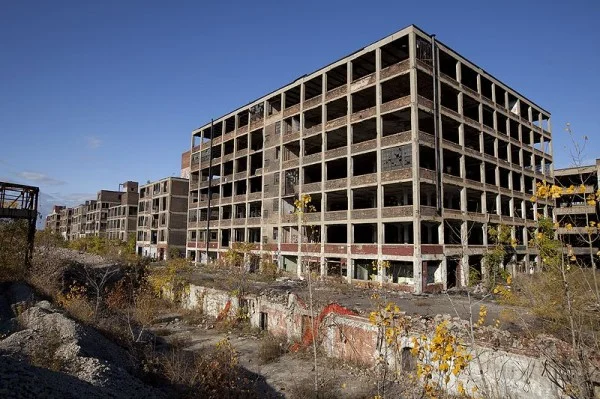
Shrinkage is not a new phenomenon. During the post-war years in the US, the middle classes fled in hordes from dense city centers to rapidly developing suburbs, aspiring for space and racial homogeneity, thus hollowing out the city cores. In the present context, however, intra-city shrinkage is not planners’ primary concern. In fact, many American suburbs are shrinking as well. Cities in the Rust Belt grew in an era when large-scale manufacturing required large amounts of labor. With much of their traditional labor force no longer as in demand in the modern economy, many Rust Belt cities such as Detroit face population and economic decline. Leaders in these cities have attempted different strategies, with varying success, to reinvent their image and their economy around creative industries, a manufacturing renaissance, or the service sector.

Decline of Detroit. Source: http://en.wikipedia.org/wiki/File:Abandoned_Packard_Automobile_Factory_Detroit_200.jpg.
But shrinkage today is a complex phenomenon, not limited just to the Rust Belt. It is afflicting much more heterogeneous regions, including those around the Californian cities of Fresno, San Francisco, and San Jose. It should be noted that the time period when shrinkage was observed in these cities mostly coincides with the 2001–2002 recession. During this time, San Jose did indeed lose population at a rate of three per thousand or so for a two-year period. However, while the rate of population decline was at about three per thousand in 2002 and 2003, the number of occupied housing units appears to have increased over the same period at a rate of seven per thousand. This may mean that the shrinkage observed is San Jose may just a change is demographics, like change in size of household. It may not be valid to call San Jose a shrinking city, as shrinkage may be just a temporary result of a city in flux.
Aksel Olsen’s paper argues that shrinkages in Eastern European cities, the Rust Belt in the US, and in the Californian so-called “Sun-Belt” cities are not comparable. In fact, bundling them together creates a fuzzy definition, watering it down to the point where it is no longer useful to describe the vastly different trajectories of urban evolution. The scholarly definition of shrinking cities is ‘a densely populated urban area with a minimum population of 10,000 residents that has faced populationlosses for more than two years and is undergoing economic transformations with some symptoms of a structural crisis.’ A tighter definition, taking into account specific contexts, would be more helpful to planners.
The typical definition of a “shrinking city” is flawed in two key ways. First, it fails to distinguish shrinkage due to an aging population from shrinkage due to shifting industries. Each requires different policy strategies. A lower fertility rate may be a long-term problem, but in the short term, the migration balance matters more because it has a greater effect on the economically active population. Further, a thriving city center may still experience population growth despite industries moving out. The San Francisco Bay Area during the Dot Com Crisis of the years 2000–04 would be an example of population growth and a changing job base. This distinguishes a Detroit from a San Francisco.
Second, the typical definition of shrinking cities is too shortsighted. Planners should look at the long term. Olsen equates short-term forecasts of “shrinkage” to comparing ‘weather’ with ‘climate’, one representing short-term changes and the other, long-term structural changes.
A city with a rapidly growing economy might shrink deliberately, to create a better quality of life for a smaller population, or may going through a phase of transition. In the 1980s, Pittsburg began to focus on high-end retail. Pittsburgh seems to be in the midst of a transition to an entertainment economy, even as the city continues to lose population, again underlining the complex patchwork of prosperity and decline, here at the city scale. Despite half a century of population loss due to industrial decline, Pittsburgh is, if not thriving, certainly outperforming both the Rust Belt and the nation as a whole. Its unemployment rate of 7.8% is well below the national average.

Pittsburgh Skyline. Source: http://commons.wikimedia.org/wiki/File:Pittsburgh_Skyline.JPG.
Should shrinking cities then be defined as simply a state of being, defined on the basis of population loss or job loss? Or should a deeper investigation be made into its underlying causes? The latter is essential, if the city has to devise policy directions to deal with the situation. Growth and decline are a part of the natural cycle of a city’s life. If short-term fluctuations are assumed to reflect broader trends, urban policy-makers will fail to identify the true causes of shrinking cities resulting in uninformed policy decisions and a trivialization of the issue. Planners should think about ways to preserve affordable housing to prevent gentrification when there is rapid growth occurring.
Olsen’s paper left me convinced that contextual analysis, that is, a qualitative typology to define shrinking cities instead of a quantitative one, would lead to more useful observations. These can serve as a comparative framework for analyzing similar cities worldwide. A qualitative approach leads to more relatable comparisons between shrinking cities of erstwhile East Germany and the Rust Belt in the US, instead of the Sun Belt.
I would argue for uncoupling ‘prosperity’ from ‘ever increasing growth’, and urge cities to plan for ‘smart decline.’ Shrinkage may not always be a bad thing. In the words of Aristotle: “A great city should not be confounded with a populous city.”
Tanvi Maheshwari is a Master of Urban Design student at UC Berkeley. She is interested in urbanism of the global south and segregation in the public realm. She can be reached at tanvi@berkeley.edu.
How the Other Half Lives: Exploring Trailer Parks in the American Sun Belt
I believe that trailer parks are an important source of affordable housing for low-income households. I also believe that they serve as an important transitional step for social mobility. These conclusions are a culmination of a complex and emotional, although enriching personal journey of writing my senior thesis at UC Berkeley.
As an urban studies undergraduate, I first sought to investigate the concept of colonias because to me it represented the Third World phenomenon of informalities on First World territory. The journey began in the summer of 2012 when I received the Judith Lee Stronach Summer Travel Scholarship to explore poor migrant settlements near the U.S.-Mexico border. During my travels, I drove along the U.S.-Mexico border through the States of California, Arizona, New Mexico and Texas to study this phenomenon of underdevelopment. But what I saw was very different from what I expected, based on the academic papers and scholarly books I had read.
Naively, I had expected to find isolated pockets of poverty that could be addressed through institutionally coordinated efforts and proactive legislation. But what I found were not isolated settlements but whole poverty-stricken neighborhoods, suburbs and, in some cases, cities, built entirely of mobile homes and trailer parks. I had never inquired into this scattered pattern of settlement clusters before, where people seemed to be camping permanently in mobile homes over the vast expanse of desert land. Initially, residences looked empty, isolated and neglected, uprooted and restless. But after spending a few weeks in the Sun Belt, I began to question my preconceived notions about life in the desert. I became conscious of very different ways of life that exist outside American metropolises. I started to wonder whether there was not one, but multiple American Dreams.

Instead of just focusing on colonias, I decided to make trailer parks a central part of my research since they represent a lion’s share of low-income housing in California. Tracing back trailer park evolution in history allowed me to better understand how they had become such a big part of American culture. I also learned about the complex social, economic, environmental, and cultural challenges in the border region and its relationship to the trailer settlements within the state in the UC Berkeley course, “The U.S.-Mexico Borderlands,” taught by Professor Michael Dear in the Fall semester of 2012.
Following my travels, I learned that throughout the 20th century, U.S.-Mexico border issues and American planning ideology have precipitated negative attitudes towards trailer parks and low-income population residing within. Institutional, social, and economic barriers impeded the transition to conventional housing and reinforced the status quo of the informal trailer park stature. I, then, incorporated the infamous Duroville settlement as a case study in order to examine life in an informal trailer park with the most dramatic conditions. Finally, my research came full circle to cumulatively encompass first world informalities, trailer parks and colonias—all in one paper.
When Assistant U.S. Atty. Leon Weidman declared that the Duroville Trailer Park’s “leaking sewage, 800 feral dogs, piles of debris and fire hazards are a deadly threat to its roughly 5,000 tenants” and should be closed immediately, locals were not surprised. The farm belt of California is full of people living in their cars or in beat-up trailers. Some don’t even have that; they sleep outside. Duroville trailer park, located in the Imperial Valley, consists of about 200 trailers, with a population varying from 2,000 to 6,000, depending on the growing season in one of the most productive agricultural industries in the nation.
Duroville was first formed in 1999 when, according to the New York Times, the local Indian tribe leader, Mr. Duro, declared that the new trailer park on the reservation would be free of local code-enforcements. Coincidentally, Riverside county officials had just decided to clear out illegal trailer settlements in the area, which created a large demand among the low-income population. Indian reservations with their lax land use policies empowered trailer park owners to shun certain housing responsibilities and exploit the vulnerable and desperate trailer park population that had nowhere else to go. Subsequently, Duroville degenerated into a slum-like settlement with terrible living conditions.
Duroville is a culmination of a long history of systemic trailer park exclusion, discrimination and abuse that have precipitated since the trailer park heyday of the World War II Era. However, Duroville is just one of many cases illustrating the affordable housing crisis in California. Thousands of people live in severely substandard housing in California where the waiting list for affordable housing contains thousands of people.
In the current context, local governments lack political and financial capacity to address the affordable housing crisis, and therefore continue institutional efforts to zone or regulate low-income trailers out of sight or existence. While redevelopment agencies are being shattered and counties are unlikely to cough up millions of dollars to relocate the residents in the near future, life in low-income trailer parks goes on as usual. As humble as home can be in the trailer park or illegal trailer community, most residents prefer self-sufficiency to dependency. Moreover, there is great deal of pride involved in achieving “homeownership” status, stability associated with real estate ownership and benefits with raising a family in a close-knit community. As the Duroville community clearly demonstrated, trailer parks can achieve an incredible unity and coherence at beating the odds of survival in the worst of conditions and represent a dynamic vernacular environment worth of the American Dream.
Many Americans, by choice or out of necessity, live in trailers permanently and at odds with the current regulations and social ideals. Society’s refusal to reevaluate the housing needs of the poor contribute to the shortage of affordable housing. In my research and this blog post, I hope to bring awareness to the little-known community life that has been burgeoning in trailer parks and elucidate the evidence that trailers remain the last resort of affordable housing for low-income populations.
Tomas Janusas is a senior in Urban Studies in the college of Environmental Design at UC Berkeley. Born and raised in Vilnius, Lithuania, he now lives in San Francisco. He is a curious fellow in everything urban, and especially fascinated by beautifully perverse American urbanism. You can find him at tomasj@berkeley.edu.