

Geographies of Tech Wealth: San Francisco to "Silicon Border"
As the companies, workers and wealth of Silicon Valley creep north into the city of San Francisco, the effects of an industry with a relatively small but highly paid labor force are leading to widespread social unrest. Embodied in the symbolic protests around “Google Buses,” lower-income residents are reacting to tech’s ability to produce so much wealth that is thinly distributed to a small labor force, disinvested from local infrastructure (with private transportation), and funneled to comically useless purposes like the “Google Barges” mysteriously floating in the Bay. However, conversations about tech wealth are often limited to its distribution—with even mainstream economists (as well as The Economist) conceding that, “Facebook will never need more than a few thousand employees.” Clearly, the other side of this is production; even with its relatively small labor force, Facebook can generate billions in wealth and profits. Instagram, the hip photo sharing mobile application, famously had only 13 employees when it sold for $1 billion (that’s around $77 million per employee).
As the companies, workers and wealth of Silicon Valley creep north into the city of San Francisco, the effects of an industry with a relatively small but highly paid labor force are leading to widespread social unrest. Embodied in the symbolic protests around “Google Buses,” lower-income residents are reacting to tech’s ability to produce so much wealth that is thinly distributed to a small labor force, disinvested from local infrastructure (with private transportation), and funneled to comically useless purposes like the “Google Barges” mysteriously floating in the Bay. However, conversations about tech wealth are often limited to its distribution—with even mainstream economists (as well as The Economist) conceding that, “Facebook will never need more than a few thousand employees.” Clearly, the other side of this is production; even with its relatively small labor force, Facebook can generate billions in wealth and profits. Instagram, the hip photo sharing mobile application, famously had only 13 employees when it sold for $1 billion (that’s around $77 million per employee).
What is going on is not only a lack of distribution but an industry’s ability to generate massive profits without the need of a sizable labor force.
San Francisco: Canary of “Wageless Life”
If Detroit is the metropolitan victim of “deindustrialization,” then San Francisco is the victor of the “high-tech economy.” But the centrality of San Francisco in new modes of profitability is experienced in highly unequal ways. While the clashes between long-time residents and the inflow of high-wage “techies” are amplified by the geographic constraints of the San Francisco peninsula, this isn’t just a story about inequality, nor about a lack of housing supply as some cheekily imply.
More than inequality, San Francisco’s unrest stems from a population facing an economy that no longer needs them. Those being evicted from communities of color are not only facing gentrification but also perpetually low-wage labor in an economy that doesn’t need them to produce competitive profits.
Economist and presidential advisor Larry Summers made headlines early this year when he shared his fears of “secular stagnation”--effectively insufficient demand to grow the economy. But as Michigan economic sociologist Greta Krippner has pointed out, this is not a new process, since the rise of “financialization” in the 1980s was already a response to the economic stagnation that began in the 1970s in the U.S. It is in the context of what appears to be the geographic limits on U.S. profits (because of limits of domestic demand, global competition, and over production) that tech provides an avenue for profitability relatively unencumbered by the physical constraints of labor and time.
Working hand in hand with financial speculation, tech is the new industry with the promise of fixing the West’s “New Growth Conundrum.” Chillingly, as the eviction of Bay Area workers foreshadows, a larger economic transition may push a significant part of the domestic labor toward what Yale historian Michael Denning has called “wageless life.” For Denning, these are workers who are a “relatively redundant population,” or to borrow a term from a different context, “populations with no productive function [in the tech economy].” Demand doesn't seem to be the root problem as Summers suggests, as expansions in credit access and the household debt burden have long buttressed wageless demand.
Some might note that high-wage jobs in San Francisco aren’t the only jobs generated by the tech economy. This is true, and following the money of the information economy eventually leads one abroad.
“Silicon Border” and Microwork: The Travels of Tech Wealth
To say that tech and the information economy do not distribute wealth is not to deny that it travels. Of course, venture investments and speculative growth are enabled by flows of global capital. However, equally dynamic is the outsourced production of microchips and the novel “Impact Sourcing” or socially targeted “microwork,” both of which skip the domestic U.S. labor force and seem to be jumping directly to the global South, pre-branded as a poverty solution too!
Tech wealth, in the form of wages, is distributed to somewhat familiar outsourced manufacturing sites. One peculiar example of tech wealth’s international travels is a 4,500-acre free enterprise zone in development not a mile south of the U.S.-Mexico border outside Mexicali. Dubbed “Silicon Border,” this commercial development is managed by the firm Jones Lang LaSalle, whose website prominently features their “2014 World’s Best Outsourcing Advisors” recognition.

Rendering of phase 1 of Silicon Border development, to include a “Science Park” as well as housing and a commercial units. Source: Silicon Border.
Marketing its first of four phases, investors seeks to attract tech industrial work for semiconductor manufacturing, boasting the site’s “Asian manufacturing cost structure in strategic North American location, [Mexican] Government incentives ranging from tax holidays […] free trade zone status […] with USA and 43 additional countries [and] access to reliable electric power, fresh water, waste water treatment and fire suppression systems [in the middle of the Yuma desert].”
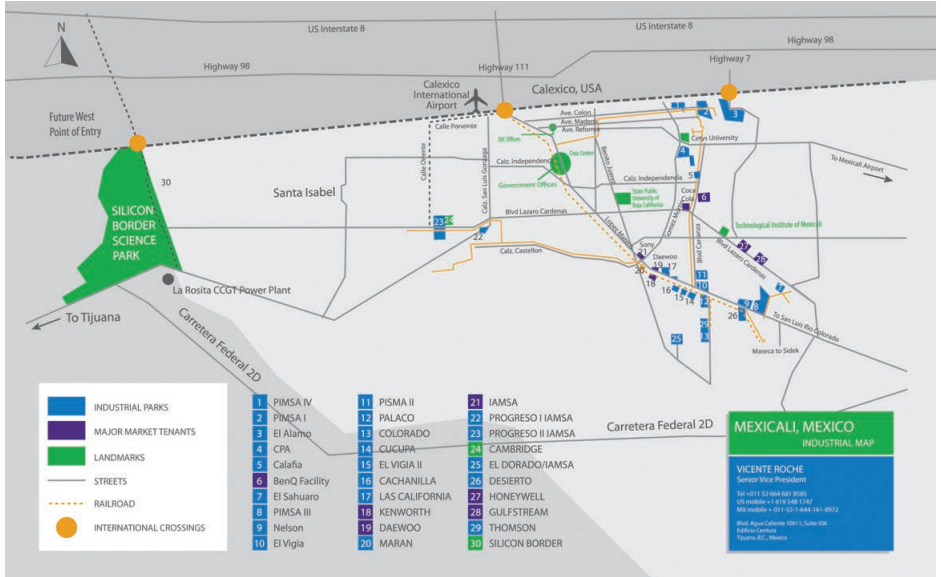
Map produced by Silicon Border developers shows the massive scale of the development when compared to Mexicali, with a population of 700,000. Also, blue boxes represent other, smaller, manufacturing parks all built along international railways and international ports of entry. Source: Silicon Border.
If Silicon Border represents an adaptation of well-known models of securing cheap manufacturing labor abroad, the novel emergence of “microwork” is outsourcing with a social conscious. Microwork initiatives operating globally seek to build a business model around recruiting un- or underemployed workers to perform simple data-based tasks online (think of it as a global information assembly line). While the microwork model is in its infancy, it has already attracted companies like LinkedIn, Google, and Microsoft to this “pay-as-you-go” labor model. Differentiated from outsourcing with the brand “socially targeted sourcing,” this model is promoted as a 21st century solution to poverty that provides not only employment but equips workers with information and communication skills. In the words of the Rockefeller Foundation, social targeted sourcing generates both “financial and social value.” A report commissioned by the Rockefeller Foundation last year estimated that the market for microwork sourcing could rise to $20 billion by 2015.

Diagram mapping the locations of Impact Sourcing Service Providers, most operating in the global South. Source: Rockefeller Foundation.
Perhaps rather than questioning the distribution of tech wealth, we should question the terms of its production and forms of its global movements. The travels of tech wealth are dynamic, but profoundly uneven and unequal. As UC Berkeley MCP student Christina Gossmann shows, there even exists an extensive economy of electronic waste in the rubbish dumps of Kenya—a nation that is working to connect to streams of tech wealth by marketing itself as a potential “Silicon Savannah.” (Also see the Silicon Cape initiative in South Africa).
The eviction of working class families from San Francisco, and rise in inequality, should not be approached as a starting point, but rather as a symptom of a dangerous shift in production to rely heavily on tech wealth. The effects of this are not only domestic, but also unequally global, as this short article has suggested.
To quote artist and journalist Susie Cagle’s brilliant animation of the “class wars” in San Francisco: let’s stop talking about buses, “let’s talk money.”
Luis Flores is a Judith Lee Stronach Fellow at UC Berkeley and runs the Collective History Archive, an interactive oral history platform on debt, the recession, and the “New Economy.” He is a research intern at Causa Justa :: Just Cause. Luis can be reached at jr.luisf@gmail.com
A New Mid-Market Street: Who is Left Behind?
All eyes seem to be on San Francisco’s Market Street these days. A long-stalled planning effort to redesign the street to improve conditions for transit, bicycling, and walking – dubbed the Better Market Street project – is at last progressing, with a final design concept being decided upon in the coming months. The many agencies involved in the project have struggled to create a unified vision for the corridor, since its character is so multifaceted and the street serves many competing roles. The backbone of San Francisco’s transportation network and its cultural center, Market Street is arguably the City’s most important street. Cutting diagonally from the waterfront on the edge of the Financial District all the way to the foot of Twin Peaks, Market Street is simultaneously a connector, a dividing line, and a place of its own.

Mid-Market has long been a place of concern – almost every Mayor in recent memory has made efforts to “clean up” the so-called blighted area. Directly adjacent to the Tenderloin and Civic Center neighborhoods, this middle section of Market Street is troubled by homelessness, drug addiction, prostitution, and other quality-of-life issues. On some blocks, almost half of storefronts are vacant and many buildings are falling into disrepair. Attempts to spark vitality by reviving the area’s roots as a theatre and arts district have only been somewhat effective. Now, the new concept is to reorient Mid-Market into a technology hub, which means remaking the area to attract newcomers, largely to the detriment of current residents.
In 2011, San Francisco officials enacted a package of loans, grants, and tax breaks to lure investors to Mid-Market. Though controversial, the plan seems to be producing results. Twitter’s arrival last year was the subject of most headlines, and other big technology firms like Dolby Labs and mobile-payment service Square have also recently moved into the area. But the allure is not just tax breaks – younger workers are increasingly forgoing life in the suburbs for a more lively urban experience. The advent of corporate shuttle buses carrying thousands of workers who live in the City to their jobs south of San Francisco each morning makes this point very clear. Tech firms are realizing this and are beginning to move the center of gravity from Silicon Valley to San Francisco, situating themselves where their employees want to live and work. Retail businesses are correspondingly turning-over, with expensive coffee shops, gourmet restaurants, and boutique chocolatiers taking their place. Change is afoot.
By early next year, the 754-unit luxury apartment complex NeMa (standing for “New Market”) will be complete, bringing thousands of new affluent residents to the area. A good number will work in the burgeoning tech industry. Mid-Market’s revitalization involves a very real change in the area’s identity, as the City caters to those who stand to bring the most capital into the area, with little attention given to the thousands who live on the streets and in low-rent housing. Just last month, police shut down an over 30-year tradition of Tenderloin residents playing chess on Market Street’s sidewalk – one of the corridor’s only visible images of community. SFPD Capt. Michael Redmond said the games had “turned into a big public nuisance” and he suspected they were “a disguise for some other things that are going on,” such as drug dealing and gambling. This once-forgotten stretch of Market Street is suddenly valuable, and the last thing the City wants to do is scare affluent people away.
What will all these changes ultimately mean for the neighborhood? Market Street will surely continue to be a place where people of all walks of life come together, but a process of harsh gentrification is nevertheless occurring. As Mid-Market reorients itself to be attractive for a younger and more affluent demographic, current lower-income residents are viewed as a nuisance – an expendable population tolerated only until renewal takes-off. San Francisco needs to reflect on the type of city it wants to be. As things are going, there will need to be a big change in perspective, unless it wants to relegate itself to being a playground for the rich.
Mark Dreger is working towards his Masters in City and Regional Planning at UC Berkeley, concentrating in transportation and urban design. He is a San Francisco native and interested in the nexus between systems of mobility and the public realm.